 (519) 204-7230

Vision Therapy in London, Ontario
A doctor-supervised program that trains your eyes and brain to work together — helping children read more easily, adults find relief from screen fatigue, and concussion patients recover lost visual function.
A doctor-supervised program that trains your eyes and brain to work together — helping children read more easily, adults find relief from screen fatigue, and concussion patients recover lost visual function.
Vision therapy is sometimes described as physiotherapy for the eyes and brain. Good eyesight — seeing 20/20 on a chart — is only part of how vision works. Your eyes also need to team together, track smoothly, and focus quickly for reading, learning, sports, and everyday tasks to feel effortless. When those visual skills break down, no pair of glasses can fix it on its own. Vision therapy uses a structured, doctor-prescribed program of in-office and take-home exercises to retrain the eyes and brain to work together properly, addressing the root cause rather than just the symptoms.

Convergence insufficiency, lazy or crossed eyes (amblyopia and strabismus), and difficulty keeping both eyes working together as a team.
Skipping or re-reading lines, losing your place, poor reading comprehension, and visual skill gaps that get mistaken for attention or learning difficulties.

Blurred or double vision, dizziness, light sensitivity, and reading fatigue following a concussion or traumatic brain injury.
Struggling in school, avoiding reading, or getting headaches with schoolwork can point to an underlying visual skill deficit rather than a learning or attention problem.
Screen fatigue, headaches, and difficulty focusing after long hours on a computer are often signs that your visual system needs retraining, not a stronger prescription.
From sharpening reaction time and depth perception to recovering visual function after a concussion, we help patients get back to full performance and daily life.
"I have improved immensely. The possessive eye has relatively subsided, where it now just rapidly blinks the odd time when it is strained. Further, due to the improvement, my glasses can now be changed where the prescription is not as intense and strong as it used to be. The dizziness and nausea I once felt every time I would slightly bend over, has yet to occur since Dr. Suwala's help. If I do feel these symptoms, it is due to exhaustion more so than my eye. Further, my visio-spatial setback has slowly dwindled. I am now more aware of my surroundings than I was prior to; although I still have a long way to go, there has been progress. I have yet to shut anything on myself since. I no longer experience as strong of a sensitivity to light as I once had. I can now sit in a room with the lights on bright and not be bothered by it. Dr. Suwala has done follow-up testing each week on my peripherals to see how they are improving, and what once was a questionable circle is now more defined and slightly expanding. Prior to the exercises, the circle was all squiggly and small. Now, there are more smooth connective lines that have a larger circumference than before.
When I first started doing the exercises I felt discouraged. I was doing everything necessary to progress and improve; however, it felt like I was remaining at the state I started in. It was not until I went to Dr. Suwala for a check in that he said how much my eyes have improved — not only the right, which is severely impaired, but also the left, which he thought didn't have any more room to improve upon. Further, the green and purple lens is what changed my perspective on whether I can truly repair my deficits or not. Once I finish staring into a light with each lens, it is an indescribable feeling. It's as if everything got brighter, clearer, and focused. The effect of this exercise gives me confidence and happiness. Although this feeling only lasts for an hour or so, it is that exact moment that I feel, with Dr. Suwala's help, I can improve to an acceptable point where I can function on my own, not have any problems, and will eventually no longer need the therapy exercises. Therefore, not only has Dr. Suwala helped me with my eye impairments, but he has also helped me with my self-esteem."
— A Patient
"I am 60 yrs old and have been having vision issues for years. I have had trouble with stairs and doorways for years. When we lived on the farm, I was always falling down. My vision had deteriorated to the point where reading was becoming more and more difficult. I pretty much quit driving because I knew I wasn't safe, so the only way I could get around was if my friends or children drove me.
When I began seeing Dr. Suwala, he decided that I had the wrong prescription strength glasses. Then he started working with me to improve the quality of my vision. I wanted to see about laser surgery for my eyes, but Dr. Suwala convinced me that it would be better to improve the control over my eye muscles. After a few weeks of therapy and a new prescription for my glasses, I felt improved enough to purchase a car and get my independence back. After a year of eye therapy and exercises, Dr. Suwala felt I could get the laser eye surgery and have it be a real benefit to me.
I feel the quality has already improved, and I can't wait to lose my total dependence on glasses. I really feel that this has been a journey for me — I feel that I am regaining control of my life, and that my confidence and quality are improving in leaps and bounds. I feel that my needs as a whole person were important to both Dr. Suwala and his staff. They have encouraged me, and I have always felt that they cared about me, my goals, and my well-being.
Anyone considering wanting to improve their vision should consider talking to Dr. Suwala and his staff. Don't let age stop you — you only get one life, and you should have as much quality of life as you can get."
— A Patient, 60
This handwriting-copy exercise, used to track visual-motor and tracking skills, shows one child's improvement over the course of vision therapy.
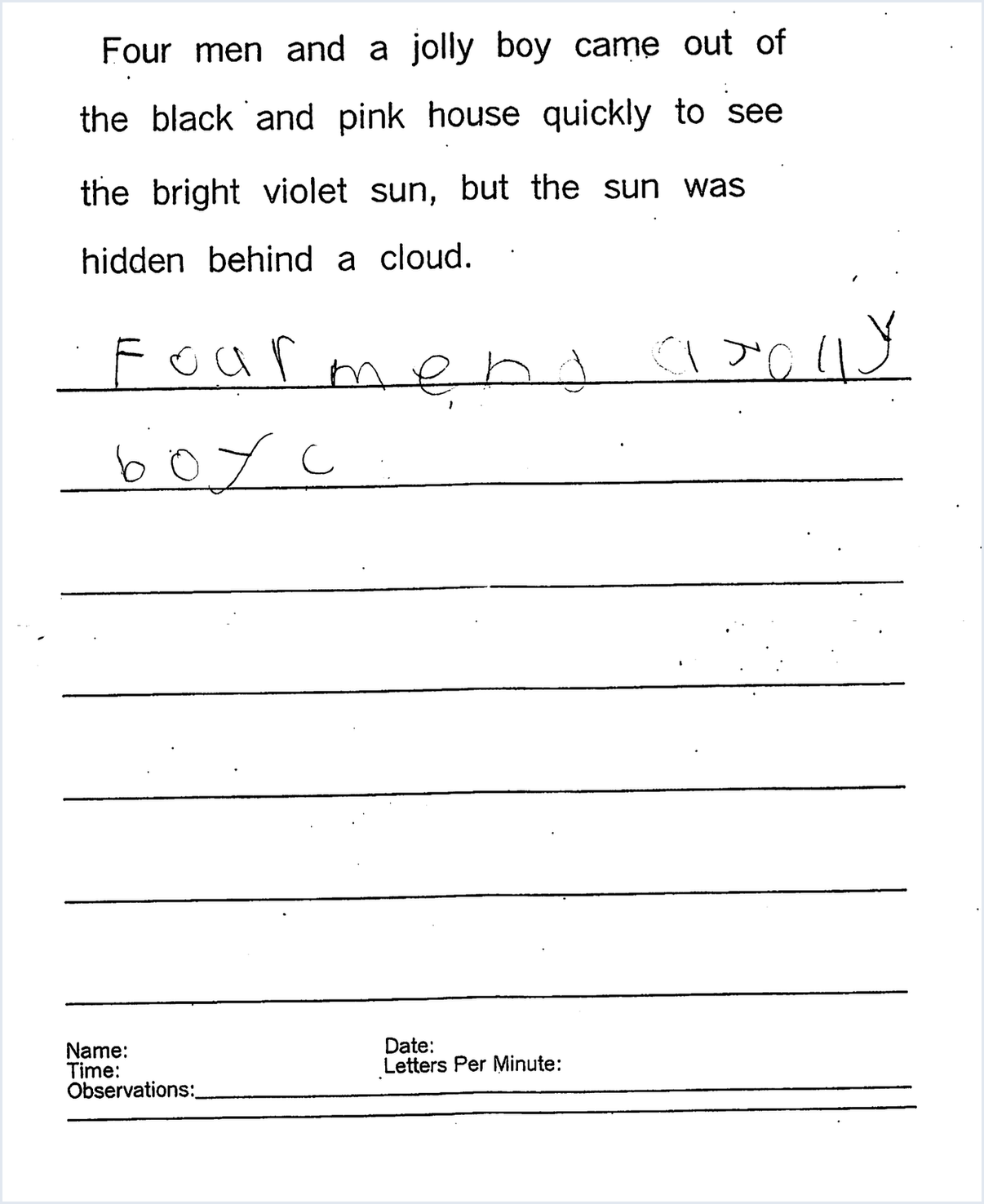
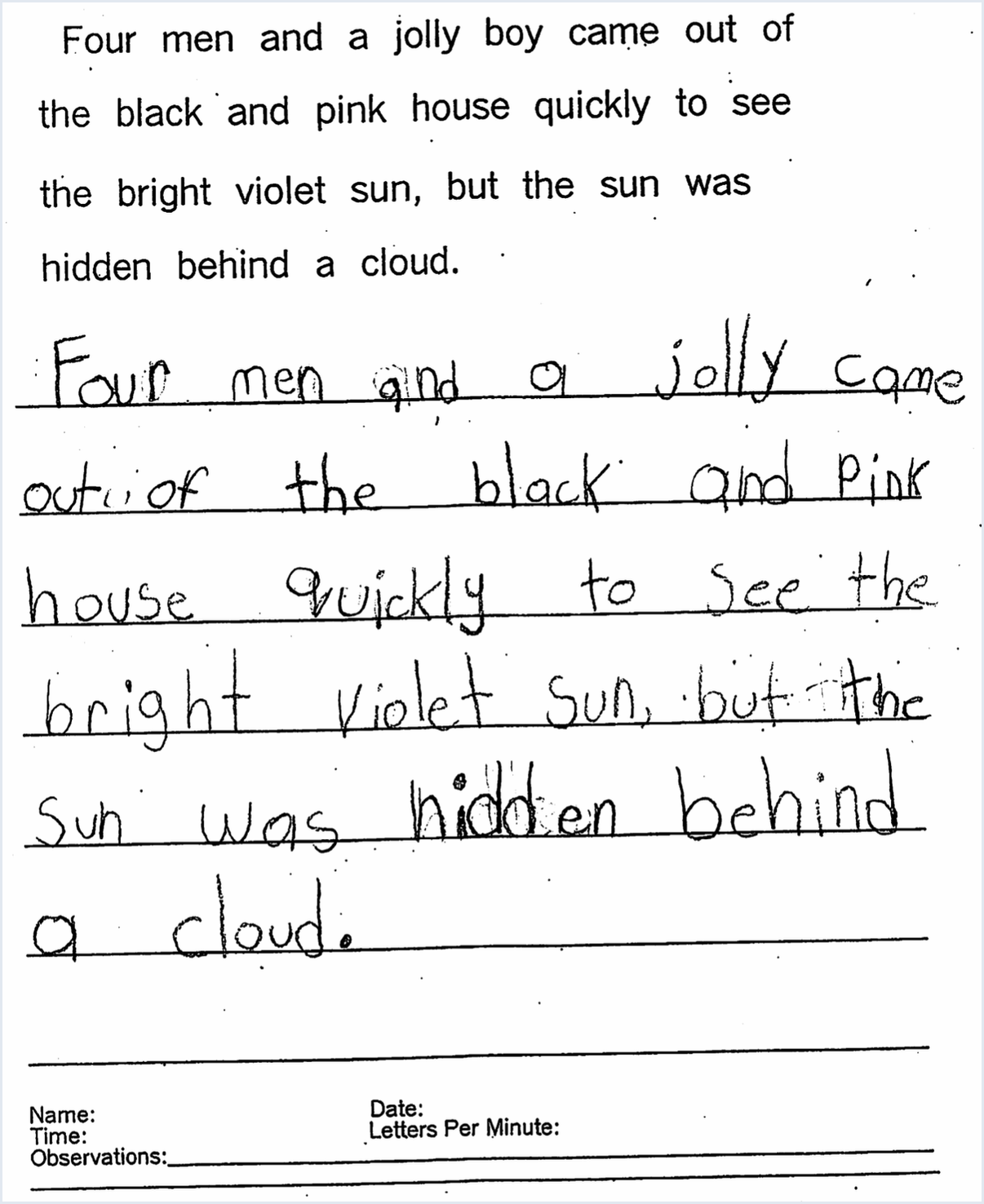
Every program starts with a comprehensive evaluation of your visual skills — well beyond a standard eye exam — to identify exactly where the breakdown is happening. From there, Dr. Suwala or Dr. Buxton designs a personalized plan of in-office sessions and home reinforcement exercises, often paired with neuro-functional glasses. Progress is tracked and the plan is adjusted along the way, so treatment stays matched to how you're actually responding. No referral is needed to get started — book your assessment online, or read our FAQ for answers to common questions about coverage and what to expect.